 Sizu
Home › Books › Your Kid’s Math Homework Didn’t Have to Be This Hard
What this book is
One method at a time, in plain English: what it is, a picture of it drawn the way your child is asked to draw it, why schools teach it that way, how it connects to the method you learned, and exactly what to say at the kitchen table: the questions that help, the slip to watch for, and how to help without doing the work yourself. The new methods aren’t a different kind of math. They are the arithmetic you know with the steps written out where a child can see them, and the standard written methods still come later.
It builds in the order children meet the ideas: place value; number bonds, the open number line and the column method; arrays, times-table strategies, the area model and division by chunking; fractions and decimals with strips, number lines and grids; bar models for word problems, the equals sign and estimating; time, money, measuring and graphs; and finally math facts, how to help without taking over, and a field guide to every method. Every calculated number was computed by program and checked a second way, and every equation in the book’s sum boxes was read back off the finished pages and checked to be true.
Who it’s for
Parents, grandparents, caregivers, tutors and homeschoolers of children aged about 5 to 12 (US kindergarten to sixth grade; England Years 1 to 7) who can do the sum but can’t read the worksheet, who have said “that’s not how I learned it”, or who want to help without confusing things. Each method is given its US and its English names. It is not a workbook, not a guide to any one textbook or curriculum, and not connected with any school, publisher or standards body; your child’s teacher is the authority on their class. Every example is invented to show a method.
Every chapter, its worked examples, and its free tool
The tools are free, need no sign-up, and keep what you type in your own browser. Each opens with its chapter’s worked example loaded and draws the method (the number line, the area model, the bar model, the chunks of a division) so you can see it before you sit down together. There are free printables too: ten frames, hundred charts, place-value charts, number lines, squared paper, a fraction wall and bar-model mats. The book is complete without them.
Part One · Why It Looks Different
The answers haven't changed, only the routes: schools teach the ideas under the procedures first (number sense, seeing numbers as parts), with concrete, pictorial and abstract steps, and the standard methods still follow later.
Tool: Homework Method FinderWorked examples 1–7
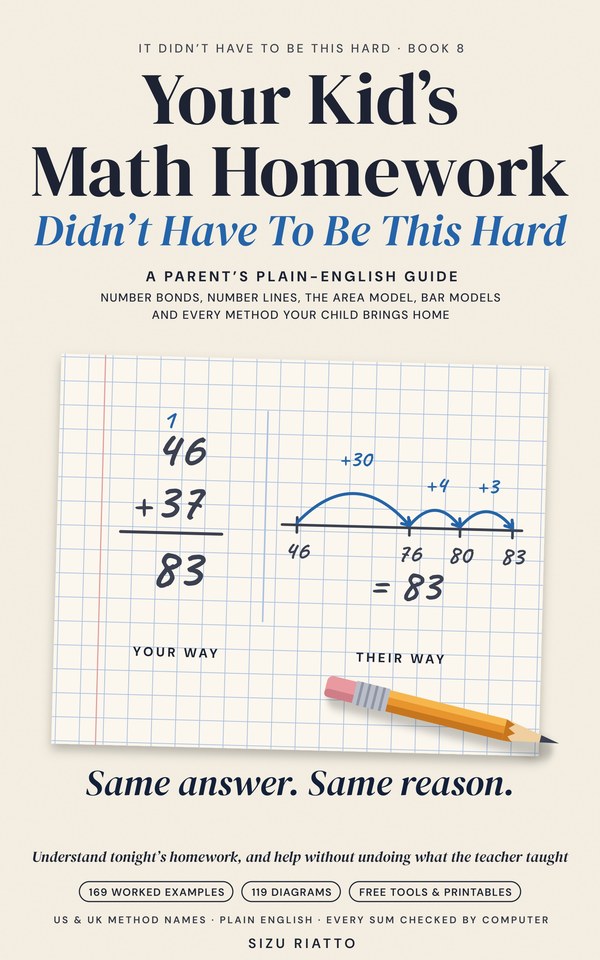
- Adding 46 + 37 the column way and the tens-then-ones way
- A right answer marked down because the number line was missing
- Three bags of four oranges: real things, a drawing, a number sentence
- Decompose, compose, regroup: decoding the worksheet's vocabulary
- Estimating 298 + 405 before solving it
- Three good ways to add 99 + 47
- "How many more shells?" read as a comparison, not an addition
A digit's value depends on its place, and each place is worth ten times the place to its right; renaming a number (345 as 2 hundreds, 14 tens and 5 ones) is the move behind every carry and every borrow.
Tool: Place Value ExplorerWorked examples 8–15
- Bundling 47 straws into tens and ones
- Why three hundred six is written 306, not 3006
- Writing 4,528 in expanded form (partitioning)
- Renaming 345 with base-ten blocks
- Comparing 1,089 and 1,098 from the left
- Multiplying by ten: the digits move left
- Dollars, dimes and pennies in $3.47
- The four values of the 5s in 5,555
Part Two · Adding and Subtracting
A number bond shows a whole and its parts, a ten frame shows how many more make ten, and "make a ten" turns 8 + 5 into 10 + 3, a method that still works for 38 + 5 and 98 + 5.
Tool: Number Bonds and Make-a-TenWorked examples 16–23
- A number bond for seven, and every way to split it
- How many more make ten on a ten frame
- Adding 8 + 5 by making a ten
- An egg carton and the near double 6 + 7
- The fact family for 5, 8 and 13
- Solving 15 − 9 by adding up from 9
- Nine plus anything: borrow one to make a ten
- Change from a dollar for a 65¢ snack
An open number line records the jumps of a mental calculation: jump tens, then ones, landing on friendly tens, and subtract by counting up the distance between two numbers, which makes borrowing across zeros disappear.
Tool: Open Number LineWorked examples 24–31
- Adding 46 + 37 in jumps on an open number line
- Adding 58 + 26 by jumping to sixty first
- Adding 47 + 29 by adding thirty and taking one back
- Subtracting 82 − 37 by counting up
- Subtracting 74 − 38 by counting back
- 503 − 298 with no borrowing
- Turning 62 − 29 into an easier subtraction with the same gap
- Change from $20 for a $13.65 book, counted up
Partial sums add hundreds, tens and ones separately at full value; the column method does the same additions from the right and passes each extra ten (or hundred) to the next column, and that carried 1 is a ten, not a one. Subtracting, a too-small digit is fixed by exchanging one from the left for ten (what "borrowing" really means): the number is renamed, never changed.
Tool: Column Addition and Subtraction, Step by StepWorked examples 32–39
- Adding a read-a-thon's minutes by partial sums: 368 + 257
- What each carried 1 means in 368 + 257
- Giving away 27 of 52 stickers with base-ten blocks
- Books left on the library shelves: 724 − 351 with an exchange
- Evening ticket sales: subtracting 403 − 158 across a zero
- Catching the classic slip in 52 − 27 by adding back
- How many years apart two trucks are: counting up beats columns
- Miles left on a road trip, checked by adding back
Part Three · Multiplying and Dividing
Multiplication counts equal groups, and an array shows them as a rectangle of dots; turning, doubling, halving and splitting that rectangle gives strategies (the turnaround, doubles, fives from tens, nines from tens, split a hard fact) that rebuild any forgotten fact from known ones, on the way to memorizing them all.
Tool: Times Table Strategy FinderWorked examples 40–47
- Juice boxes for a soccer team: four packs of six
- A muffin tray turned around: 3 × 5 and 5 × 3
- Crayons in eight boxes by doubling: 8 × 6
- Counting 14 nickels: fives from tens
- Days until a class trip: 9 × 7 as ten sevens minus one
- Showing a strategy for 7 × 8 by splitting it
- Eggs in six dozen boxes: the twelves
- From a 6 × 6 square to 6 × 7
The area model splits each number by place value, multiplies every part by every part as rectangles, and adds the pieces; partial products are the same pieces in a column, and every line of the old long multiplication (including the zero on the second line, which is the tens of the bottom number) is a row of those boxes.
Tool: Area Model MultiplierWorked examples 48–55
- Students on a field trip: 23 × 4 with one row of boxes
- Tiles for a patio: 34 × 27 with the area model
- 34 × 27 by partial products
- 34 × 27 by the standard algorithm, and why the second line has a zero
- Sheets in 32 boxes of paper: 125 × 32 in six boxes
- 99 × 6 as a hundred sixes minus one six
- 46 × 23 by the lattice method, and why the diagonals work
- Checking 34 × 27 with an estimate
Division asks either how many in each group (sharing) or how many groups (grouping); the meaning of a remainder depends on the story; partial quotients take away easy multiples of the divisor and add up how many were taken, and short and long division are the same chunking with the biggest chunk at each place value and the zeros left off.
Tool: Partial Quotients and Long DivisionWorked examples 56–63
- Cookies on plates and cookies in bags: sharing and grouping
- 56 ÷ 7 from a related multiplication fact
- Cars, stickers and dollars: what a remainder means
- Boxing 156 cupcakes in sixes by partial quotients
- Packing 432 eggs in cartons of 12 with bigger chunks
- 156 ÷ 6 as a rectangle with a missing side
- Stages of a 936 km ride by short division (the bus stop)
- Boxes for 7,452 pencils: long division beside partial quotients
Part Four · Fractions and Decimals
A fraction's bottom number says how big the equal pieces are and the top number counts them, so a bigger bottom means a smaller piece; strips and number lines show every fraction as an amount with its own place on the line.
Tool: Fraction Wall and Number LineWorked examples 64–71
- Is a sandwich cut into four pieces cut into fourths?
- A third or a quarter of the same granola bar
- Placing 3/4 on a number line from 0 to 1
- Finding fractions equal to one half on a fraction wall
- Giving away 3/4 of 20 stickers
- Which is greater, 3/8 or 4/7, without drawing
- Seven quarter-cups of oats as a mixed number
- Putting 2/3, 5/8 and 3/4 in order
You can only add pieces of the same size, so the bottom number stays the same when you add; when the pieces differ, cut them into a size both can make (a common denominator), and subtract mixed numbers by regrouping a whole or by counting up on a number line.
Tool: Adding Fractions with StripsWorked examples 72–79
- Painting 2/5 and then 1/5 of a fence
- Why 1/4 + 1/4 isn't 2/8
- Two children's shares of a pan of cornbread
- A walk of 2/3 mile and then 1/4 mile
- Two days of rain, in eighths of an inch
- A weekend's reading time in mixed numbers of hours
- How much of a 4 1/4-mile trail is left
- Ribbon left over after cutting a piece off
"Of" means multiply: a whole number times a fraction is equal jumps, and a fraction of a fraction is the overlap in a rectangle cut both ways, which is why tops and bottoms multiply; dividing asks how many fit (or how much in each share), and you flip because the flipped fraction is how many fit into one whole.
Tool: Fraction Area Model and How Many FitWorked examples 80–87
- Yogurt for three smoothies at 2/5 cup each
- How many of 12 cupcakes get chocolate frosting
- A class eating 2/3 of the brownies that were left
- The area of a garden bed with mixed-number sides
- How many 1/3-yard bows from 4 yards of ribbon
- Three friends sharing half a pizza
- Bagging trail mix in twelfths of a pound
- How many 3/4-cup scoops fit in 3 cups
A decimal is place value carried past the ones, each place a tenth of the one before, so give decimals the same number of places to compare them, line up the places to add or subtract, and read the area model to see why tenths times tenths make hundredths; a hundred grid shows decimals and percents as the same squares.
Tool: Decimal Grid and Place ValueWorked examples 88–95
- Shading 0.3 on a hundred grid
- Which is greater, 0.7 or 0.65
- Adding 3.4 and 1.25 without the alignment slip
- Change from $5 after spending $2.36
- 2.4 × 1.3 with an area model
- Dividing 4.8 by 10 and multiplying 0.36 by 100
- Finding 35% of 60 from 10% and 5%
- The cost of three notebooks at $2.85
Part Five · Word Problems and Big Ideas
Draw a word problem as bars, one bar cut into parts or two bars compared, and put a question mark where the unknown is: a missing whole means add, a missing part or a difference means subtract, whatever the words say.
Tool: Bar Model BuilderWorked examples 96–103
- Red and blue beads: finding the whole from two parts
- Pages left to read in a library book
- Birds on a fence: the start is the unknown
- How many more baseball cards one child has than another
- A team that scored 18 fewer points
- A bake sale: what was baked, then what was left
- Bags of marbles plus some loose ones
- Money left after buying a book and a game
Draw the amounts as equal units, count the units, find what one unit is worth and build the answer; "a fraction of what's left" means drawing the leftover again, and the bar is the same thing as an algebra equation, drawn.
Tool: Bar Model BuilderWorked examples 104–111
- Stickers: three times as many, 48 in all
- Two children's money: $40 more, $180 together
- How many of 40 students walk to school
- A jar of marbles from the number that are red
- Spending a third, then a quarter of what's left
- Moving marbles so two jars are equal
- Boys and girls in a club in the ratio 2 : 3
- The sticker problem as a bar and as algebra, side by side
The equals sign means "is the same amount as", so a missing number is whatever makes both sides balance, and whatever you do to one side you do to the other; function machines, patterns and the distributive property are the first steps of algebra.
Tool: Balance the EquationWorked examples 112–119
- Filling the box in 8 + 4 = □ + 5
- Deciding whether an equation is true or false
- Missing numbers in an addition and a subtraction
- A "times 3, then add 1" machine, forward and backward
- Why 3 + 4 × 2 is 11, not 14
- Toothpicks for a row of 20 squares
- Solving 3n + 5 = 26 on a balance
- 6 × 47 split into 6 × 40 and 6 × 7
Round from the original number to whichever friendly ten, hundred or thousand it's nearer (halfway rounds up), estimate before you calculate, and if the answer and the estimate disagree, believe the estimate until you find the mistake.
Tool: Rounding and Estimating on a Number LineWorked examples 120–127
- Rounding 67 to the nearest ten
- Rounding a number that sits exactly halfway
- Why rounding in two steps can go wrong
- Estimating a three-number sum, then adjusting
- Estimating a division with numbers that divide easily
- How many buses a field trip needs
- An estimate that catches a wrong multiplication
- Checking a division by multiplying back
Part Six · Time, Measures and Graphs
An hour is sixty minutes, not a hundred, so find elapsed time on a number line by jumping to the next o'clock, then by hours, then the last minutes; count coins from the biggest down and give change by counting up from the price.
Tool: Elapsed Time and Making ChangeWorked examples 128–135
- Reading quarter past and quarter to on a clock
- Reading the minute hand by counting in fives
- How long until soccer practice ends
- When to start getting ready for the school bus
- How long a movie is, and why subtracting times like numbers fails
- Counting quarters, dimes and pennies
- Change from $10, counted up like a cashier
- Writing 14:30 as a 12-hour time
Perimeter counts lengths around the edge, area counts unit squares inside, and volume counts unit cubes inside; the formulas (2 × (l + w), l × w, l × w × h) are fast ways of counting them, and any shape made of rectangles can be cut into rectangles.
Tool: Area, Perimeter and VolumeWorked examples 136–143
- Perimeter and area of an 8 by 5 foot rug
- A rabbit pen from 24 feet of fence: which shape holds most?
- The floor area of an L-shaped room, cut two ways
- Patio tiles in equal rows: counting becomes multiplying
- Cubes packed in a box, counted in layers
- A child's height and a shelf, from feet to inches
- A plank in centimeters and a bag of flour in kilograms
- A garden's width from its perimeter and length
Read the title, the key and the scale (and where the axis starts) before reading any bar; most graph questions are then a total, a difference ("how many more") or a mean, which is a fair share found by leveling out.
Tool: Pictograph and Bar Graph MakerWorked examples 144–150
- Books read, on a pictograph where each star is 2 books
- Favorite fruits on a bar graph that counts by tens
- Cans collected for a food drive on two days
- Birds at a feeder, counted in bundles of five
- How much six bean plants grew, on a line plot
- Towers of cubes leveled out to find the mean
- A reading club's growth on a fair and a misleading graph
Part Seven · Helping at the Kitchen Table
Strategies first, then memory: a few rules (× 0, × 1, × 2, × 5, × 9 and turnarounds) cover all but fifteen of the hundred one-digit times facts, and make-ten, doubles and near doubles do the same for addition; build any forgotten fact from a neighbor you know.
Tool: Math Facts by StrategyWorked examples 151–157
- Shrinking the hundred times facts to the fifteen worth learning
- The few addition facts the strategies don't cover
- Building 7 × 8 from 5 × 8
- A make-ten card game at the kitchen table
- England's multiplication tables check, and what six seconds means
- A dice game for practicing doubles
- Math facts from a license plate on a long drive
Ask, don't tell: five questions (what do you know, what are you trying to find, can you draw it, what have you tried, how could you check) leave the thinking with the child; let mistakes be found by checking, and stop with a kind note to the teacher when the night has run out.
Tool: Homework Helper PrintablesWorked examples 158–163
- Five questions that unstick a word problem about a fourth grade
- A child teaches a parent the area model for 26 × 14
- A subtraction slip found by checking with addition
- Grandpa's column method beside partial products for 46 × 3
- Knowing when to stop, and the note to send instead
- Three-quarters or two-thirds of a pizza, over dinner
Every method splits a number, pictures it, records the steps or checks them; the field guide names each with its US and English names, and ten habits (place value, make a ten, count up, draw it, estimate, ask don't tell) carry across all of them.
Worked examples 164–169
- 24 × 15 by halving and doubling, area model, columns and lattice
- 600 − 247 by counting up, constant difference and columns
- A game that costs three times as much as a book
- 3/4 − 1/3 with fraction strips
- 846 ÷ 6 by partial quotients and short division
- An estimate that catches a dropped zero in 312 × 19