 Sizu
Home › Books › Business Numbers Didn’t Have to Be This Hard
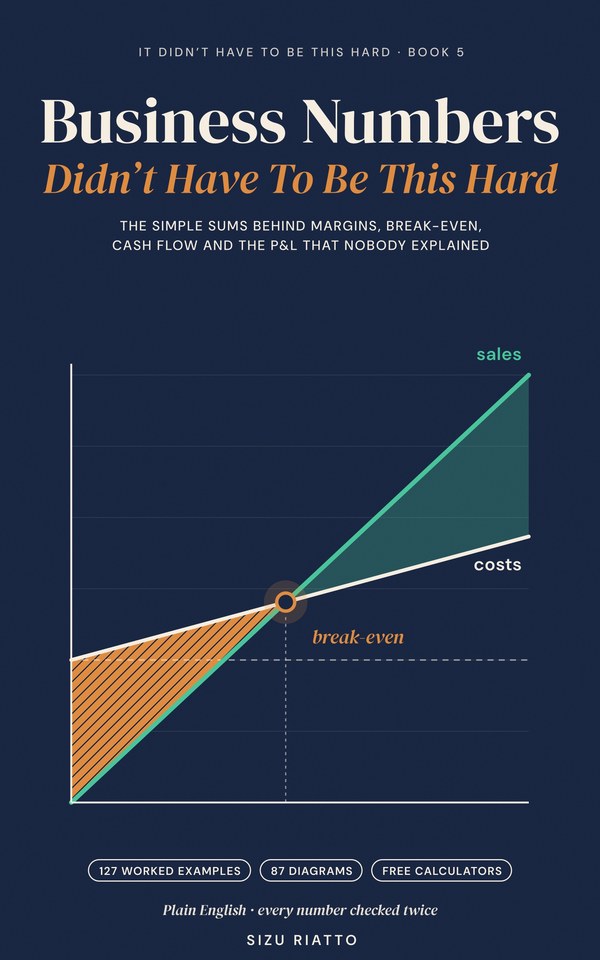
What this book is
The working arithmetic of business, explained slowly, from the very beginning. What revenue, contribution and profit each tell you. Why fixed and variable costs drive almost every decision. Margin against markup, and how to price for a margin the right way. Break-even in one division. What a discount really costs. How to read a profit and loss in ten minutes, why a profitable business can run out of cash, and how to read a balance sheet. Payback, return and net present value. Growth rates that mislead, unit economics, churn and lifetime value. Budgets and variances, capacity, and the handful of numbers worth watching.
It’s written for a new manager, a first-year owner, a freelancer and anyone who nods in the finance meeting and looks it up afterwards. Four invented businesses carry the stories: a candle maker, a chain of bike shops, a houseplant subscription and an electrician. It is arithmetic, not advice: it doesn’t cover tax or law, which differ by country. Every number in it was computed by program and checked a second way.
Every chapter, its worked examples, and its free calculator
The calculators are free, need no sign-up, and keep what you type in your own browser. Each one opens with the book’s own example loaded. The book is complete without them.
Part One · The Sums of Selling
Calculators: Three Profit Levers
Worked examples 1–4
- A first day at a market stall: revenue, costs and profit
- Price, volume or cost: which 10% lever adds most profit
- Two shops: big sales against a healthy profit margin
- A coffee shop's weekly profit, per year and per hour
Calculators: True Unit Cost · Fixed or Variable?
Worked examples 5–10
- The variable cost of one handmade candle
- Average cost per unit falling with volume
- A rainy market day: what a fixed fee does to a bad day
- A step cost: hiring a second mechanic
- Unsold stock and the sunk-cost trap
- The high-low method: splitting delivery costs
Calculators: Markup and Margin · Price for a Margin
Worked examples 11–16
- One helmet: margin against markup
- Pricing a lock for a 40% margin, and the common mistake
- A supplier's price rise: keep the margin, the price or the gain?
- A handmade product's margin and markup
- A store's gross margin for a quarter
- Pricing a restaurant dish from its food cost
Calculators: Contribution and Product Mix
Worked examples 17–21
- Contribution and contribution margin of one product
- The sale that pays the month's fixed costs
- Four products ranked by margin, contribution and per hour
- A hotel's special order: spare capacity or full?
- A department that "loses money" after shared overheads
Calculators: Break-Even Planner
Worked examples 22–28
- Break-even for a small shop
- Break-even with a target profit for the owner
- How far sales can fall: the margin of safety
- A price cut and the new break-even
- A new hire's effect on break-even
- Break-even with three products and a changing mix
- A one-off fair: break-even with an opportunity cost
Calculators: Price Change · Hourly Rate
Worked examples 29–34
- A tradesperson's hourly rate from billable hours
- A fixed-price quote, and what an overrun costs
- The extra sales a price cut needs
- The sales a price rise can afford to lose
- Target costing: the most you can pay a supplier
- A workshop price test: fewer jobs, more contribution
Calculators: What a Discount Costs
Worked examples 35–41
- What 20% off takes from gross profit
- Stacked discounts: 20% then 10% is not 30%
- Multi-buy deals as discounts
- A free-delivery threshold: who gains and who costs
- A win-back voucher and the customers who'd buy anyway
- A loss leader: inner tubes sold at cost
- A bulk discount from a supplier, and the cash it ties up
Part Two · Reading the Statements
Calculators: P&L Reader
Worked examples 42–47
- Reading a whole profit and loss statement
- Gross, operating and net margin
- A common-size profit and loss
- Three product lines' share of sales and of gross profit
- Two years side by side: sales up, profit down
- Operating leverage: a tenth more or less in sales
Calculators: Profit to Cash · Cash Runway
Worked examples 48–53
- A profitable wholesale order that runs out of cash
- An annual bill: profit view against cash view
- A profitable month where cash fell
- Owner's drawings and loan repayments against profit
- A cash flow statement in three streams
- Cash runway for a business that isn't profitable yet
Calculators: Cash Cycle
Worked examples 54–60
- Days of stock, receivables and payables: the cash cycle
- Cash freed by carrying less stock
- A slow-selling product line's days of stock
- Growing wholesale sales on credit, and the cash it needs
- An early-payment discount as a yearly rate
- The cash tied up by customers who pay late
- A supermarket's negative cash cycle
Calculators: Balance Sheet Ratios · Statement Tie-Out
Worked examples 61–67
- Reading a whole balance sheet
- Four transactions and the balance sheet equation
- How profit and drawings tie the P&L to equity
- Current ratio and quick ratio
- Debt to equity
- Return on equity and return on assets
- A small shop's first balance sheet
Calculators: Depreciation · Payback and ROI
Worked examples 68–74
- Straight-line depreciation of a van
- A vehicle's cost per billable hour
- Payback on new workshop equipment
- Return on investment after depreciation
- A big purchase: one month's P&L against the bank
- Leasing or buying a coffee machine: total cash
- Repair the old van or replace it: cost per year
Part Three · Growth, Customers and Time
Calculators: Growth Rate
Worked examples 75–82
- Down 20% then up 20%, and the rise needed to recover
- Percentage points against per cent
- Monthly growth compounded over a year
- Average growth against the CAGR
- The base effect: small numbers, big percentages
- A seasonal business: month on month against year on year
- Real growth after price rises
- The rule of 72
Calculators: Order Economics
Worked examples 83–88
- The contribution of one subscription box
- Every cost of one online order, including the advert
- Per-order and per-dollar costs: the smallest order that pays
- Own website against a marketplace, per order
- A launch promotion that loses money on every order
- One café visit, and the visits a day must cover
Calculators: Customer Value
Worked examples 89–97
- Monthly churn
- Average customer lifetime from churn
- Customer lifetime value from contribution, not revenue
- Acquisition cost, LTV to CAC and payback
- How many customers remain after a year
- Cutting churn and lifetime value
- The subscriber ceiling: new customers ÷ churn
- An annual plan against monthly billing
- A café regular's yearly value, and pricing a loyalty card
Calculators: Net Present Value
Worked examples 98–103
- Present value of money next year
- Paid less now or in full later?
- Net present value of new equipment
- Lease or buy in present value
- A business loan's monthly payment and total interest
- Paying a year's rent up front: the rate it earns
Part Four · Running It
Calculators: Budget Variance
Worked examples 104–110
- A month's sales against budget
- Splitting a sales variance into price and volume
- A flexed budget for a variable cost
- A gross profit variance fully explained
- Planning a year in three cases
- Multiplying a busy month by twelve
- Updating a forecast halfway through the year
Calculators: Utilisation and Capacity
Worked examples 111–116
- A team's utilisation and what each point is worth
- What an unbilled hour costs a service team
- Finding the bottleneck in a workshop
- Overtime against a part-time hire
- Sales per person and per square metre
- Perishable capacity: filling an exercise class
Calculators: Funnel and Mix
Worked examples 117–121
- Every line's margin up, the total margin down: the sales mix
- Website visits up, orders down
- An online sales funnel and how improvements multiply
- High margin against more gross profit dollars
- A KPI that improves by turning work away
Worked examples 122–127
- Per what period? A branch's quarterly profit
- Growth slower than the market
- Sales up, volume down: separating price
- A return rate: points or per cent
- What a subscriber target needs to be true
- Should she open a second shop? The whole book on one decision