 Sizu
Home › Books › Estimation Didn’t Have to Be This Hard
What this book is
Estimating explained slowly, in plain English, from the very beginning. Being roughly right is a method, not a talent: keep one digit and drop the rest, think in powers of ten, split a question nobody can look up into small pieces anyone can guess, carry a dozen anchor numbers, set bounds you’re sure of, and let the units check your working. Each habit gets its own chapter, shown on real situations, with the working set out step by step and a shortcut you can do in your head.
It builds in order. Part One is the toolkit: rounding, powers of ten, big numbers you can feel and mental arithmetic. Part Two is the method: Fermi’s trick, anchors, bounds, why the errors cancel, and units. Part Three estimates everyday time, money, areas, crowds and growth. Part Four checks claims, spots numbers that can’t be true, gives honest ranges and plans projects. Part Five sizes a market and works out big questions about the planet, checked against published values. Every calculated figure was computed by program and checked a second way, and every equation in the book’s sum boxes was read back off the finished pages and checked: exact ones to be true, estimates to be as close as the book says.
Who it’s for
Anyone who says “let me get back to you” when asked for a rough number, and wishes they didn’t. Anyone who reads numbers in the news, in reports or on invoices and wants to know in a minute whether they’re plausible; who has a job interview coming with “how many…?” questions; who plans projects, events, trips or home jobs and wants a quick first answer; or who has a curious child asking enormous questions. No math assumed beyond whole-number arithmetic. Every story is invented to show a method; it is arithmetic, not financial or professional advice.
Every chapter, its worked examples, and its free calculator
The calculators are free, need no sign-up, and keep what you type in your own browser. Each opens with its chapter’s worked example loaded. The book is complete without them.
Part One · The Rough-Number Toolkit
An estimate is a quick calculation on friendly numbers with its assumptions on show. Aim only as close as the decision needs (within 10%, a factor of 2, or a factor of 10), measure misses as factors, and let the estimate catch the big mistakes.
Calculator: Rough vs Exact: How Far Off?Worked examples 1–7
- Hours for an office move, on the back of an envelope
- Is it worth driving across town to save $6?
- A county fair's gate count with too many digits
- Three yardsticks: checking a bill, planning a party, sizing the unknown
- Measuring a miss as a factor instead of a percent
- An invoice for office chairs with an extra digit
- Will a catering order fit the budget?
The leading digit carries almost all of a number's size, so round to one significant figure and do the arithmetic on that. Keep two digits when the number starts with 1 or 2, lean your roundings different ways in a product, and round the big items carefully in a sum.
Calculator: Round to One or Two DigitsWorked examples 8–14
- Rounding to one significant figure, from thousands to hundredths
- Why numbers that start with 1 need a second digit
- Rounding one number up and the other down
- A month of household bills, rounded where it counts
- Three cautious roundings that end up nearly three-quarters too high
- An hourly wage turned into a yearly figure
- How many days for a 1,287-mile road trip
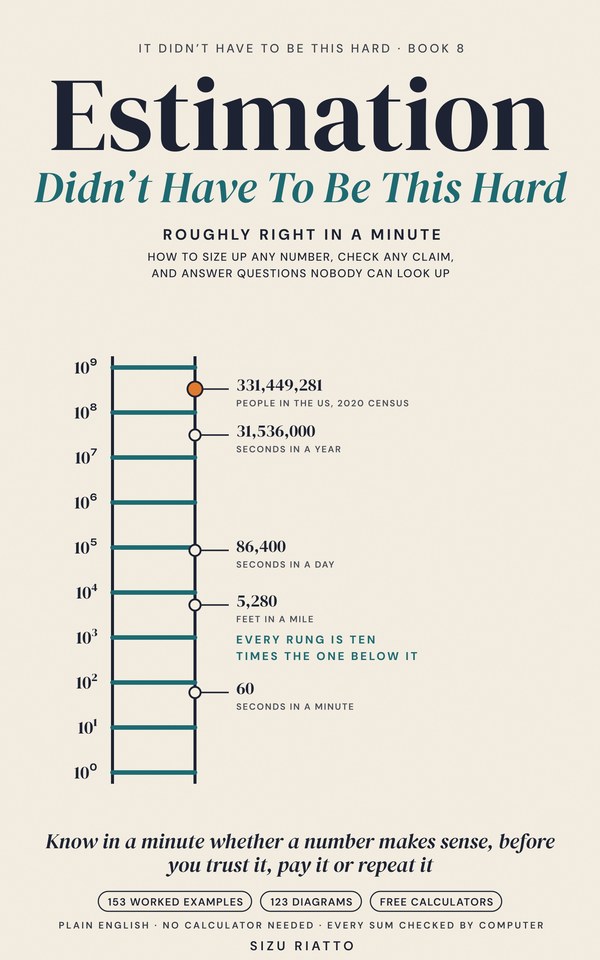
Every number sits on a powers-of-ten ladder, and its rung is its order of magnitude. Write big and small numbers as a digit times a power of ten, multiply by adding exponents and divide by subtracting them, and when you're unsure across a wide range, aim for the middle rung.
Calculator: Powers of Ten and Scientific NotationWorked examples 15–21
- Thousand, million, billion, trillion as powers of ten
- Multiplying big numbers by adding exponents
- A national budget shared among towns
- The speed of light and a sheet of paper in scientific notation
- Seconds in a year against people in the US
- The middle of 100 and 10,000
- How many photos fit on a 2 TB drive
Translate big numbers into time, distance, weight or money per person. A million seconds is about 11.6 days and a billion is about 31.7 years, so a million and a billion differ the way a vacation differs from a career; dividing by the people involved catches the million–billion slip.
Calculator: Big Number FeelerWorked examples 22–28
- A million seconds on the calendar
- A billion seconds as a span of years
- A trillion seconds as a thousand working lives
- How high a million and a billion bills would stack
- What a million one-dollar bills weigh
- A national program's cost per person
- A town road budget with a million–billion slip
Reshape every sum until it's easy: multiply leading digits and count the zeros, halve one number and double the other, go through 10 or 100 for 5, 25 and 1%, step to a round number and correct, and nudge a divisor to a friendly neighbor. In a product, balance your roundings; in a division, move both numbers the same way.
Calculator: Leading-Digit MultiplierWorked examples 29–35
- A consulting case question without a calculator
- Clearing away fives and halves
- Multiplying by 5 and 25 through 10 and 100
- Bus trips for a day's riders
- Small percentages built from 1%
- Products next to a round number
- Monthly costs and a season's gas, by friendly division
Part Two · Breaking Big Questions into Small Ones
A question nobody can look up is made of pieces anybody can guess; write them as a chain, multiply, say what you assumed, and check the answer by a second route that starts somewhere else.
Calculator: Fermi Chain BuilderWorked examples 36–42
- How many piano tuners work in a city, split into four guessable pieces
- How many pizzas a small town eats in a week, and a check against its pizza places
- How much gas a car burns in a year, checked against how often you fill up
- How many loaves of bread a family of four eats in a year
- A taco truck's weekly tortillas, worked from customers and from sales
- Ordering doughnuts for an office meeting, and changing one guess
- How many tennis balls fit in a school bus
Carry a dozen numbers you trust, from your own body, your home, the clock and a few sourced world facts, and build every other number from them.
Calculator: Anchor Numbers and Time ConverterWorked examples 43–49
- The seconds in a year, and the pi shortcut for remembering them
- Turning an hourly rate into a yearly and a monthly one
- Measuring your stride once and pacing a room with it
- The country's population and homes in round numbers
- How long a plane or a car would take to circle the Earth
- How long sunlight takes to reach us
- A million seconds, a week and a month, built from the seconds in a day
When you don't know a number, name a low and a high you're sure of and take the geometric middle, the number the same factor from both; then narrow it with a quick look.
Calculator: Bounds and the MiddleWorked examples 50–56
- How many leaves are on an oak, from bounds alone
- Why the plain average of wide bounds misleads
- Finding the geometric middle by counting zeros
- Narrowing the oak's leaves by counting branches, twigs and leaves
- How many books a town library holds, bounded and then counted
- A low and a high for every piece of the piano-tuner chain
- The most people a party room could ever hold
In a chain of honest guesses, some come out high and some low, so the errors mostly cancel and the answer usually lands far closer than the worst case; leaning guesses, repeated guesses and one wild piece are what break this.
Calculator: Error Spread ExplorerWorked examples 57–63
- Two guesses, each twice or half the truth: how often they cancel
- Four guesses: counting all sixteen ways a chain can come out
- Ten guesses: why the worst case is so rare
- Four hopeful guesses that compound instead of canceling
- Where to spend five minutes improving an estimate
- A toothbrush estimate and a paced floor that use one guess twice
- How close Fermi's paper-scrap estimate came
Carry the units with every number and multiply by conversion factors that equal one, arranged so the units you don't want cancel; if the unit comes out right the arrangement is right, and if it comes out as nonsense you've found your mistake.
Calculator: Unit Chain ConverterWorked examples 64–70
- Turning miles an hour into feet a second
- How much water a tank holds, and what it weighs
- Ordering concrete for a slab in cubic yards
- Gallons, hours and gas money for a road trip
- How much water one drip a second wastes in a year
- An Olympic pool in liters and in gallons
- A water tank's gallons, divided by mistake and caught by the units
Part Three · Estimating the Everyday
A time is an amount divided by a rate, and a habit is a daily time multiplied by the days; minutes a day times six is about hours a year, a mile on foot is about twenty minutes, and a line takes the people ahead divided by the people served each minute.
Calculator: Time Adder: Per Day to Per YearWorked examples 71–77
- What ten minutes a day adds up to in a year
- A daily commute, totaled for a working year
- How long a line at the counter will take
- Whether you can finish a long book before the book club
- Walking time from distance, at twenty minutes a mile
- Adding up a to-do list before promising a deadline
- A lifetime of tooth-brushing, in days
Most money questions are conversions: put prices in the same unit (per item, per day, per hour, per year) before comparing, multiply small differences by how often they happen, and use 72 divided by a yearly percentage for the doubling time.
Calculator: Daily, Hourly, Yearly and DoublingWorked examples 78–84
- A price per case against a price per cup
- A daily coffee and pastry, as a yearly total
- An hourly wage as a yearly figure
- A yearly salary as an hourly rate
- Cheap boots or pricey boots, by cost per wear
- How long 6% a year takes to double
- How long prices rising 3% a year take to double
Area is length times width and volume is area times depth, with every length in the same unit; then divide by what one unit covers or holds (the coverage on the can, say 350 square feet a gallon of paint, 27 cubic feet a cubic yard, about 7.5 gallons a cubic foot) and allow for the gaps.
Calculator: Area, Volume and Fill EstimatorWorked examples 85–91
- Measuring a backyard by pacing it
- The area of a garden bed with a corner cut off
- Cubic yards of mulch for a garden
- How much paint a room needs
- The gallons and weight of a bath of water
- The gallons in a round pool, with π as about 3
- How many boxes fit in a moving truck
To count what's too many to count, count a fair sample carefully, find how many samples make the whole, and multiply; crowds are area divided by about 10, 4.5 or 2.5 square feet a person, and a count "at once" is not a count "over the day".
Calculator: Sample-and-Scale CounterWorked examples 92–98
- Whether a street could hold the crowd claimed
- Visitors over a day from the crowd at any one time
- Jellybeans in a jar, from one quarter cup
- The words in a book, from a few lines
- Trees in a park, from three sample squares
- The people in a line around the block
- Grains of rice in a bag, by weighing
Ten doublings is about a thousand (2¹⁰ = 1,024), so count the doublings and add three zeros for every ten; 72 divided by a growth rate gives the doubling time, halving is a little quicker than the same rule says, and doubling always looks slow right up until it doesn't.
Calculator: Doubling and Halving TimeWorked examples 99–105
- Whether 42 folds of paper would reach the Moon
- Why ten doublings is about a thousand
- The rice on the chessboard, doubled 64 times
- When a mailing list growing 9% a month doubles
- When a phone losing 20% a year is worth half
- A penny doubled daily against $1,000 a day
- How many doublings from one person to 8 billion
Part Four · Checking Claims and Making Plans
Divide a big claim by the people, days or hours it's spread across until it's an amount you've seen yourself, then ask whether you'd believe that: plausible, possible but rare, or implausible.
Calculator: Per-Person, Per-Day Sense CheckWorked examples 106–112
- A bakery's claim of 2 million cupcakes a year, checked per minute
- A town's yearly coffee total turned into cups per person per day
- Water use per home turned into bathtubs a day
- Flyers delivered door to door: seconds per door
- A $36 million public project, per person and per home
- A reader's 300 books a year, in hours a day
- "One in five of 2,000 is 600": checking a claim against itself
Some numbers break limits that come with the numbers themselves: a drop can't pass 100%, shares of a whole can't pass 100%, an average sits inside its range, a part can't exceed its whole, and a day has 24 hours; when one does, look for the true number behind it.
Calculator: Claim CheckerWorked examples 113–119
- "Errors down 150%" and the right way to work out a drop
- Survey shares that add to 112%
- An average salary above the top of its own range
- 120 miles walked in a day, checked against a typical pace
- A festival crowd reported as 47,312
- 3,000 of 2,400 employees: users or uses?
- Screen time and sleep that leave no day left
Give a low, a high and a best guess; combine ranges end with end (lows with lows, highs with highs; for subtraction the ends cross), take the middle of a product range from the geometric middle (for narrow ranges, multiplying the plain middles lands close), and let overlapping ranges tell you what to measure next.
Calculator: Range CombinerWorked examples 120–126
- The oak's leaves as a low, a high and a middle
- A party budget from three cost ranges
- A gala's catering bill from a range of guests and prices
- "Give or take a factor of 2" against "plus or minus 50%"
- Why four guesses rarely all go wrong the same way
- Testing your own 90% ranges
- Will it fit in the van? Two overlapping ranges
Break a project into pieces, estimate each as amount × rate with a low, likely and high, add what happens in a row, take the longest of what happens side by side, and correct the total with your own track record.
Calculator: Three-Point Project EstimatorWorked examples 127–133
- An office move in six pieces
- Scanning 2,400 files: hours of work and days on the calendar
- Painting a room: low, likely and high
- Jobs done side by side instead of in a row
- Correcting a plan with your past projects
- A 10% buffer on a three-day job and a six-month job
- The critical path: which chain of tasks sets the finish date
Part Five · Big Questions, Start to Finish
Size a market twice, once top-down from the people (people × share who buy × how often) and once bottom-up from the sellers (sellers × sales each), take the middle, and check the answer per person. Watch for the missing step, and use a ceiling when a plan looks too big.
Calculator: Market Sizing BuilderWorked examples 134–140
- Coffee sold in a city, counted from the people
- The same coffee, counted from the cafés, and the middle of the two
- Splitting a week into weekdays and weekends
- A city's coffee market in dollars a year, checked per person
- How many dog groomers a city could support
- A backpack shop's sales plan against the most there could be
- Catching a slipped zero by dividing by the population
The biggest questions about the planet break into a few anchors and a guess or two: the air's weight is the pressure on a square inch times the square inches, the oceans are area times depth. Work them with powers of ten, then check against the published value and see which guess cost the most.
Calculator: Earth-Scale CalculatorWorked examples 141–148
- How long it would take to walk around the world
- Earth's radius from its circumference, with π as 3 and as 3.14
- Weighing the whole atmosphere from the pressure on one square inch
- The volume of the oceans from their area and a guessed depth
- How long a radio message takes to reach the Moon
- How many Earths would fit between here and the Moon
- How many baths it takes to fill an Olympic pool
- How big a square would hold everyone in the world
Ten habits tie the book together: decide how rough is enough, one digit and some zeros, powers of ten, split it up, carry anchors, bound it and take the middle, let the units check you, per person per day, give a range, and check by a second route. Start with three and the rest follow.
Worked examples 149–153
- A conference's coffee and chairs budget, carried as a range
- Driving time and gas for a weekend trip, in two passes and a range
- Checking a claim about how much rain a town's roofs could catch
- Checking a garage-sale sign by counting one box and weighing another
- How many breaths a person takes in a year, with a range