 Sizu
Home › Books › Fractions, Decimals and Percentages Didn’t Have to Be This Hard
What this book is
Fractions, decimals and percentages, explained slowly, in plain English, from the very beginning. None of the rules is arbitrary: each one is a short description of a picture. So every chapter shows the picture first (a fraction strip, a pizza, a tape measure, a receipt, a grid of a hundred squares), then the sum, then the shortcut you can do in your head, then the place you’ll use it: splitting a bill, working out a sale price, scaling a recipe, cutting a board, reading a headline.
It builds in order. Fractions from scratch, including why you “flip and multiply”; decimals, the fractions on every price tag, with rounding and the decimals that never end; percentages forward and backward, percent change and stacked discounts; ratios, rates, proportion and scaling; and finally estimating, splitting costs fairly, and averaging correctly. Every calculated figure was computed by program and checked a second way, and every equation in the book’s sum boxes was read back off the finished pages and checked to be true.
Who it’s for
Anyone who was told at school they weren’t a math person and still quietly lets someone else split the bill or check the discount. Anyone who learned “invert and multiply” and never found out why; who freezes when a recipe needs scaling; who isn’t sure what “up 20%” or “a third more” really means; who is about to help a child with fractions homework; or who is going back to study and wants the basics solid. No math assumed beyond adding, subtracting, multiplying and dividing whole numbers. Every example is invented to show a method; it is arithmetic, not financial advice. For practice afterward, see The Everyday Math Workout.
Every chapter, its worked examples, and its free calculator
The calculators are free, need no sign-up, and keep what you type in your own browser. Each opens with its chapter’s worked example loaded, and all of them do exact fraction arithmetic. The book is complete without them.
Part One · Fractions from Scratch
A fraction is a whole cut into equal pieces: the bottom number says how many pieces make the whole (a bigger bottom means smaller pieces), and the top counts how many you have. A fraction is also a division (3/4 is 3 ÷ 4) and a point on the number line; a top bigger than the bottom means more than one whole.
Calculator: Fraction PictureWorked examples 1–7
- Why a third-pound burger is bigger than a quarter-pound one
- Sharing three pizzas among four friends: a fraction is a division
- How many children's lunches: two-fifths of 30 picnic replies
- Finding 5/8 inch on a tape measure
- Reading 7/4 cups on a recipe card: improper fractions and mixed numbers
- Overtime minutes as fractions of an hour, and the pay for 1 hour 40 minutes
- Placing 2/3, 3/5 and 5/4 on a number line
Multiplying or dividing the top and bottom by the same number renames a fraction without changing its amount (4/6 = 2/3). That one move simplifies a fraction to lowest terms and lets you compare two fractions by cutting them into the same size of piece; cross-multiplying is a shortcut for the same thing.
Calculator: Fraction Compare and SimplifyWorked examples 8–15
- Two-thirds of a sheet cake, recut into sixths and twelfths
- Why multiplying the top and bottom by the same number keeps the amount
- Simplifying 18 cans left out of a 24-pack
- Putting drill bits in size order: 7/32, 1/4, 5/16 and 3/8 inch
- Comparing 17 out of 20 with 42 out of 50
- Which pie has more left, 3/5 or 5/8: cross-multiplying explained
- Finding a drill bit between 1/4 and 3/8 inch
- Simplifying 84 signatures out of 126 neighbors
You can only add or subtract pieces of the same size, so rename the fractions to a common bottom, then add or subtract the tops and keep the bottom. With mixed numbers, do the wholes and the fractions separately, borrowing a whole when the fraction being taken away is bigger.
Calculator: Fraction AdderWorked examples 16–23
- Why a half plus a third isn't two-fifths
- A 2/3 cup plus a 3/4 cup of sugar
- What's left of a pizza after a third and a quarter are eaten
- Joining two blocks end to end: adding eighths and sixteenths of an inch
- Cutting 2 3/4 feet from an 8 1/4-foot board
- Allowing for saw cuts on a 36-inch board
- Adding a week of hours in halves, quarters and thirds
- Combining 5/6 and 7/8 of a pound of flour
"Of" means times. Multiply the tops and the bottoms: the area model shows the bottoms counting the pieces the whole is cut into and the tops counting the pieces you take. Convert mixed numbers to improper fractions first, cancel common factors early, and expect a smaller answer when you multiply by a fraction under 1.
Calculator: Fraction Multiplier and Recipe ScalerWorked examples 24–30
- Halving 3/4 cup of oil in a recipe
- Two-thirds of the three-quarters of a pie that's left
- The area of a herb bed 3/4 yard by 2/5 yard
- Scaling a soup recipe from six servings to four
- The area of a plywood panel 2 1/2 by 1 1/3 feet
- A team's share of a shared software bill: canceling first
- Gallons in a 12-gallon tank that's three-quarters full
Division asks how many of one thing fit into another. With a common bottom it's whole-number division; flipping the divisor works because the flip of a fraction is how many of it fit into one whole. Dividing by anything less than one makes the answer bigger, and the fractional part of an answer is a fraction of the divisor.
Calculator: Fraction Divider: How Many Fit?Worked examples 31–38
- How many quarter-cup scoops in three cups of flour
- Dividing 3/4 by 1/8 with a common bottom
- How many two-thirds fit into 2: why you flip
- How many 1 1/4-foot shelves from a 10-foot board
- What the leftover two-thirds means when 5 feet is cut into 3/4-foot shelves
- Sharing three-quarters of a cake among three people
- Miles per hour from 15 miles in three-quarters of an hour
- Half-cup servings from 4 1/2 cups of soup, and the check that catches a wrong flip
Part Two · Decimals, the Fractions on Every Price Tag
A decimal is a fraction whose bottom is 10, 100 or 1,000, shown by the place of each digit after the point: tenths, hundredths, thousandths. Compare decimals by lining up the points and padding with zeros; turn one back into a fraction by saying it in words and simplifying.
Calculator: Decimal and Fraction ConverterWorked examples 39–45
- Two menu prices with the same digits: reading dollars, dimes and pennies
- Comparing three days of rainfall by padding decimals with zeros
- What the little 9/10 on a gas-price sign adds to a fill-up
- Halves, quarters, fifths and eighths as the decimals on price tags
- Matching a 0.375-inch drill chart size to a 3/8-inch bit
- Reading 1.25 kg of flour as a fraction and in grams
- Turning a trip meter's 12.8 miles into miles and feet
To add or subtract, line up the points so tenths meet tenths; count up from the price to check change. To multiply, ignore the points, multiply the digits, then put back as many decimal places as the two numbers had together, and check with a round-number estimate.
Calculator: Decimal MultiplierWorked examples 46–53
- Adding up a corner-market receipt and finding a double-scanned banana
- Checking change from a $20 bill the cashier's way, by counting up
- Why 0.3 × 0.2 makes six hundredths, on a grid of 100 squares
- Pricing 2.4 lb of deli turkey at $3.85 a pound
- Thirty-six cans at $0.79 each, by pricing them at 80 cents and taking a cent back
- A box of 1,000 napkins at $0.012 each: sliding the point
- A gas fill-up of 11.6 gallons at $3.39, checked with an estimate
- Three-quarters of a pound of cheese at $11.96 a pound
To divide by a decimal, slide the point in both numbers until the divisor is whole. Any fraction becomes a decimal by dividing top by bottom; it ends only if the bottom (in lowest terms) is made of 2s and 5s, and otherwise repeats, because the remainders must come round again.
Calculator: Long Division and Repeating DecimalsWorked examples 54–61
- Splitting an $87.50 lunch four ways when the cents don't come out even
- How many 60¢ seed packets $4.80 buys
- Comparing two jars of peanut butter by the price of one ounce
- Turning 3/8 into a decimal by long division
- Why a calculator's 1 ÷ 3 never stops, and why 1/7 repeats every six digits
- Telling from the bottom number whether a fraction's decimal ends: 7/40 and 7/30
- Working out miles per gallon after a 312.4-mile drive
- How many 75¢ stickers $6 buys, and why the answer grows
Round by looking at the one digit after the place you keep (5 or more rounds up). Round once, at the end; rounded parts may not add to the rounded total, so let one part take the leftover. Round up or down when the job demands it, and never report more digits than the inputs deserve.
Calculator: Rounding and Fair SplittingWorked examples 62–68
- Rounding a spreadsheet's $47.649 to the cent, the dime and the dollar
- Splitting $100 three ways and finding the missing penny
- Sales tax on three bottles, rounded per item and on the total
- A drive time quoted to four decimal places, said honestly
- Tile boxes, cars for 26 people and movie tickets: which way to round
- Why software can show 0.1 + 0.2 as 0.30000000000000004
- Reporting a fair's 1,187 visitors and $14,236.50 in ticket sales
Part Three · Percentages, Forward and Backward
A percentage is a fraction with 100 on the bottom, so any fraction becomes one by dividing and moving the point two places, and every percentage lines up on the same scale.
Calculator: Fraction, Decimal and Percent ConverterWorked examples 69–75
- A phone battery at 37%, drawn as 100 squares
- Turning a radio poll's "3 in 8" into a percentage
- A clothing label's percentages as fractions, and a 12.5% service charge
- The everyday fractions and their percentages
- A harvest that is 150% of last year's
- A savings rate of half a percent
- What share of a supper club turned up
Find 10% by moving the point, then build any percentage from tens, halves and ones; swap the numbers (8% of 25 = 25% of 8) whenever that is easier, and multiply when it's a percent of a percent.
Calculator: Percent Of and Tip BuilderWorked examples 76–83
- Finding 10% of a restaurant check
- Building an 18% tip from 10%, 5% and 1%
- Why 8% of 25 equals 25% of 8
- Working out 7.25% sales tax in your head
- A 20% tip by doubling 10%
- Volunteers who drive: a percentage of a percentage
- Percentages that are easier as fractions
- The tip buttons on a coffee-shop tablet
Part = percent × whole, so the whole is the part divided by its percentage: undo a discount or a tax by dividing by its multiplier (0.75 after 25% off, 1.0725 with 7.25% tax), never by adding the percentage back.
Calculator: Reverse PercentWorked examples 84–91
- A sweater's price before 25% off
- The price before tax from a receipt total
- What share of a month's pay went to groceries
- Take-home pay from a car cost that is 15% of it
- How many questions to pass a test at 70%
- A restaurant bill worked back from its tip
- Checking a "save 30%" sign
- Pricing a bowl so a gallery's 40% cut leaves $300
A percent change is the change divided by the starting value, and every change is a multiplier (× 1.05 up 5%, × 0.85 down 15%): equal rises and falls don't cancel, points differ from percent, and undoing a change means dividing by its multiplier.
Calculator: Percent Change, Points and Undoing a ChangeWorked examples 92–100
- How big a rent increase really is
- A price that falls and rises by the same dollars
- A gym fee that rises 50% and then falls 50%
- A savings rate from 4% to 5%: points and percent
- "Tripled", "up 200%" and "300% more"
- Running shoes up 8%, then down 15%
- The cut that undoes a 25% rise
- A small shop's 200% growth against a big store's 5%
- Rent rising 5% while pay rises 3%
When percentages pile up, multiply their multipliers: stacked discounts come to less than their sum, yearly rises compound to more than their sum, equal ups and downs lose a little, and only fixed-dollar amounts make the order matter.
Calculator: Stacked PercentagesWorked examples 101–108
- 40% off plus an extra 25% off a coat
- Discount, sales tax and a $10 coupon in different orders
- A rent that rises 3% a year for ten years
- Tipping on the bill before or after tax
- A 50% markup followed by a 30% sale
- A phone plan up 10%, then down 10%
- A car's value after three years of losing 15% a year
- "Buy two, get the third half price" as a percentage
Part Four · Ratios, Rates and Scaling
A ratio compares parts with parts; add the parts to find the whole, work out what one part is worth, and every share follows. "2 : 3" means two out of five, never two out of three.
Calculator: Ratio SplitterWorked examples 109–115
- A 3-to-1 salad dressing measured into a cup and a jar
- Mixing 1 : 2 : 3 concrete in a 12-bucket wheelbarrow
- Splitting a bulk-order refund in the ratio each person paid
- Checking a monitor's shape from its pixel size
- Lemonade concentrate mixed 1 : 5 with water
- Cats and dogs at a shelter: 2 : 3 is not two-thirds
- Comparing two fruit punches made to different ratios
A rate is one quantity divided by another; make sure the "per" is the thing you actually use, flip a rate when the other way up answers your question, put the cost on top when comparing savings, and add rates, never times.
Calculator: Unit Price and Rate ComparerWorked examples 116–122
- Average speed on a road trip
- Two packs of paper towels with different-sized rolls
- A running pace in minutes per mile as a speed
- Which vehicle swap saves more fuel
- A property tax quoted per $1,000 of value
- A round trip driven at two speeds
- How long two painters take working together
When two amounts grow together, find the amount for one and multiply (cross-multiplying is the same thing in one line); but first check for a fixed part, which doesn't scale, and for amounts that shrink as the other grows.
Calculator: Proportion and Recipe ScalerWorked examples 123–129
- Scaling a bread recipe from 6 people to 15
- Rice for 20 from a recipe for 8, and why cross-multiplying works
- Converting a restaurant bill and cash between euros and dollars
- Measuring a hiking trail on a 1 : 24,000 map
- How much paint to buy for two coats
- A taxi fare with a flat fee
- Fewer volunteers painting a fence take longer
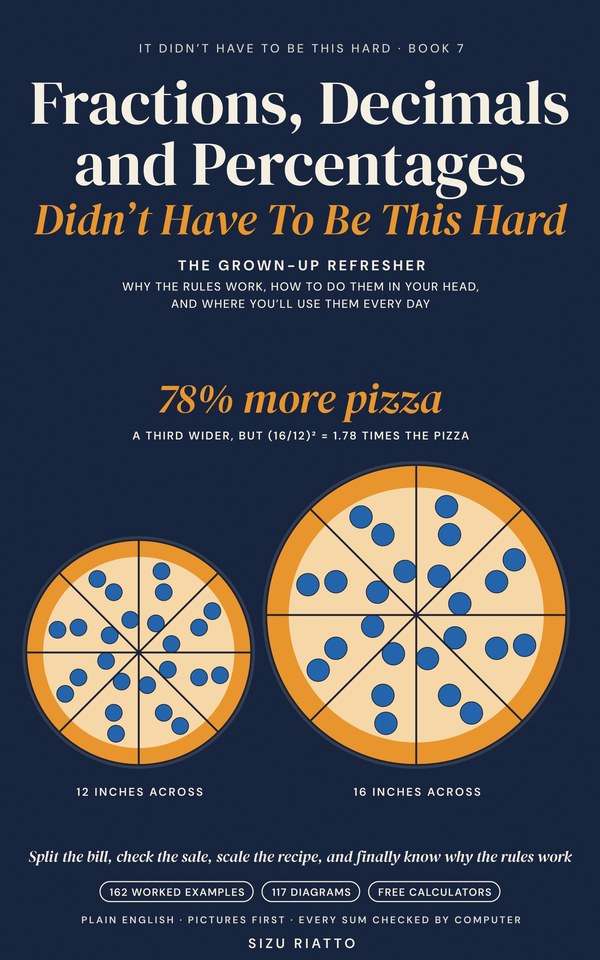
Scale every length by k and the area is multiplied by k × k and the volume by k × k × k, so a pizza a third wider has 78% more pizza, a rug twice as long each way covers four times the floor, and a box twice as big holds eight times as much.
Calculator: Size Scaler and Pizza ValueWorked examples 130–136
- Is the 16-inch pizza the better buy?
- Pricing a rug twice as long each way
- Enlarging a photo print
- Storage boxes: space against plywood
- Moving a brownie recipe to a bigger pan
- Finding a room's size from a floor plan
- Enlarging a drawing on a copier twice
Part Five · Putting It All to Work
Before you calculate, or trust a calculation, round to friendly numbers and get a rough answer. Round in opposite directions when you multiply, use compatible numbers for division, and bracket when you can't estimate in one step; if the exact answer isn't close to the estimate, look again.
Calculator: Estimate CheckerWorked examples 137–143
- A checkout total that's far too big, caught by rounding each price
- The company's share of a phone plan, by friendly percents
- A department's share of a pizza order, estimated as a half
- A weekly subscription price with a slipped decimal point
- Tax and tip on a dinner, added as one percent
- A bus hire shared by a walking group, with numbers that divide neatly
- How far along a road trip, caught between a quarter and a half
Every fair split is the whole times your part divided by all the parts. Name the whole, agree what to share it by (people, what each had, square feet, miles, nights, days), and work each share from the total; tax and tip are one multiplier, and settling up only needs each person's difference from the fair share.
Calculator: Fair Share SplitterWorked examples 144–150
- A restaurant bill split evenly, with tax and tip
- Paying for your own order plus your share of tax and tip
- Rent shared half equally and half by bedroom size
- Gas for a road trip, shared by the miles each person rode
- A vacation cabin shared by person-nights or night by night
- An electricity bill when a roommate moves in mid-month
- Settling up after a camping trip: who pays whom
When things are different sizes, don't average their percentages, prices or speeds: add up the counts underneath and divide total by total. Mixtures are weighted averages of their parts, a blend's amounts go in the opposite ratio to their distances from the target (the seesaw), and averages are easiest to handle as totals.
Calculator: Mix and Weighted AverageWorked examples 151–157
- A quiz and a test of different lengths: the real average
- A library survey at two branches of different sizes
- The real-juice share of a punch made from two juices
- A coffee blend that hits a target price, by the seesaw
- The test score needed to lift an average
- The final-exam score needed in a weighted course grade
- Equal money spent at two prices: the real price per pound
Ten habits do almost all the work: name the whole; same-size pieces before you add; "of" means times; dividing asks how many fit; line up the point and count the places; round at the end; ask "percent of what?"; changes multiply; keep parts of parts apart from parts of the whole; and estimate first.
Worked examples 158–162
- Scaling a cornbread recipe to a bigger pan
- A cabin bill with a cleaning fee and a nightly rate
- A raise and a bigger retirement contribution in the same month
- A sale flyer's stacked discounts and a spend-over coupon
- A headline about bus fares up 40% over five years