 Sizu
Fence Post Counter
Bays and posts for any run, open or closed, with the real spacing and a gate.
The weekend builder's math for posts, pickets, privacy boards and a gate that stays square, on flat ground or a slope. Start with one bay and a tape measure; finish with a fence and gate you planned, costed and built yourself.
Home › Books › Fences That Stand Straight
A project-based workbook for someone who has never set a post. Each chapter adds one number to a real fence: how many posts, where they go, how deep and how much concrete, which kind of fence, how wide the gaps, what the slope does, what the wind does, how to keep the gate square, and how much stain. The last chapter puts all nine together into a two-weekend plan, a shopping list and a ledger.
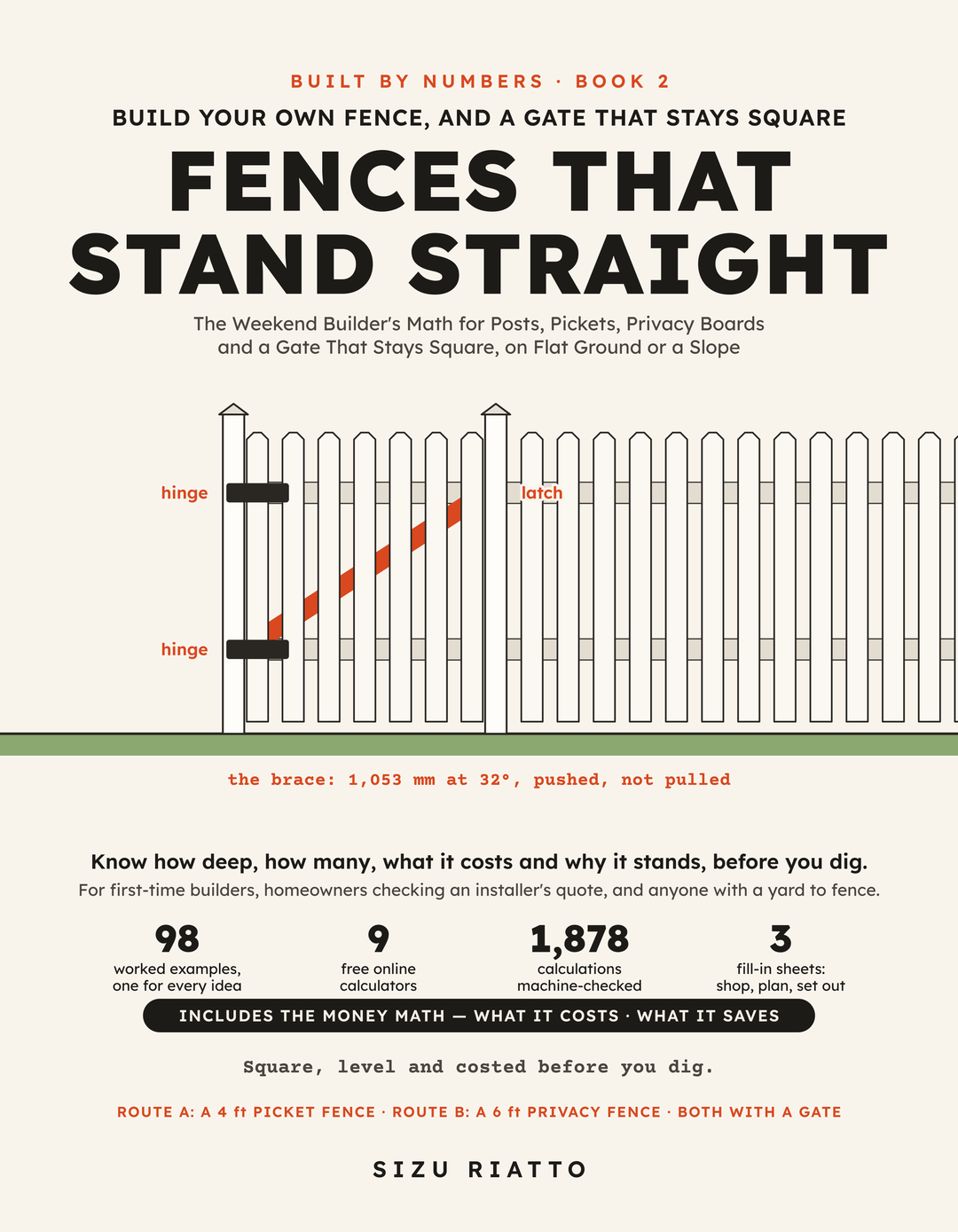
What you build: one fence line along a side boundary on ground that falls gently, with a walk gate at the house end, built one of two ways. Route A is a picket fence 1.25 m (about 4 ft 1 in) tall; Route B is a privacy fence 1.83 m (6 ft) tall, with deeper posts, more concrete and a wind check. Both share the same gate, braced from the bottom hinge corner to the top latch corner.
Who it is for: homeowners, and renters with permission, who want to build a fence and gate themselves, check an installer's quote, or choose between wood, vinyl, metal, wire, bamboo and a hedge with real numbers. Who it is not for: pool barriers, retaining fences, livestock or electric fencing, anything over 1.8 m (6 ft), and professionals. Metric first, imperial beside it; every price illustrative and dated.
The book was written in collaboration with AI tools and reviewed by the author. Its numbers are checked by a verification program, and its figures are drawn by the same program, but mistakes may remain: see corrections & errata.
Bays and posts for any run, open or closed, with the real spacing and a gate.
Post centers from one zero, 3-4-5 corners at any size, and the slope as a percent, an angle and inches per foot.
Post length, hole volume, bags of concrete per hole and in all, gravel, and the weight you are moving.
Every fence type by cost per foot and per meter, and cost per year with your own life estimate.
Equal gaps between posts or on a gate, the picket count for a target gap, and boards on a long run.
Racked or stepped: the fall per bay, rail length and cut angle, and the triangles under a stepped panel.
Wind pressure by speed, the push on one post, and what spacing and height do to it.
Gate width from the opening, the brace length and angle, the gate's weight and the pull on the top hinge.
Area to finish, gallons for your coats, and the cost per year of each kind of finish.
The three fill-in sheets from the back of the book. Take a clean one outside and keep the book indoors, away from the concrete.